

Patio covers in Phoenix: aluminum, shade sail or pergola
Three ways to shade a Phoenix backyard, and how each one handles rain, monsoon wind and the summer sun. Where a solid or lattice aluminum cover fits in.
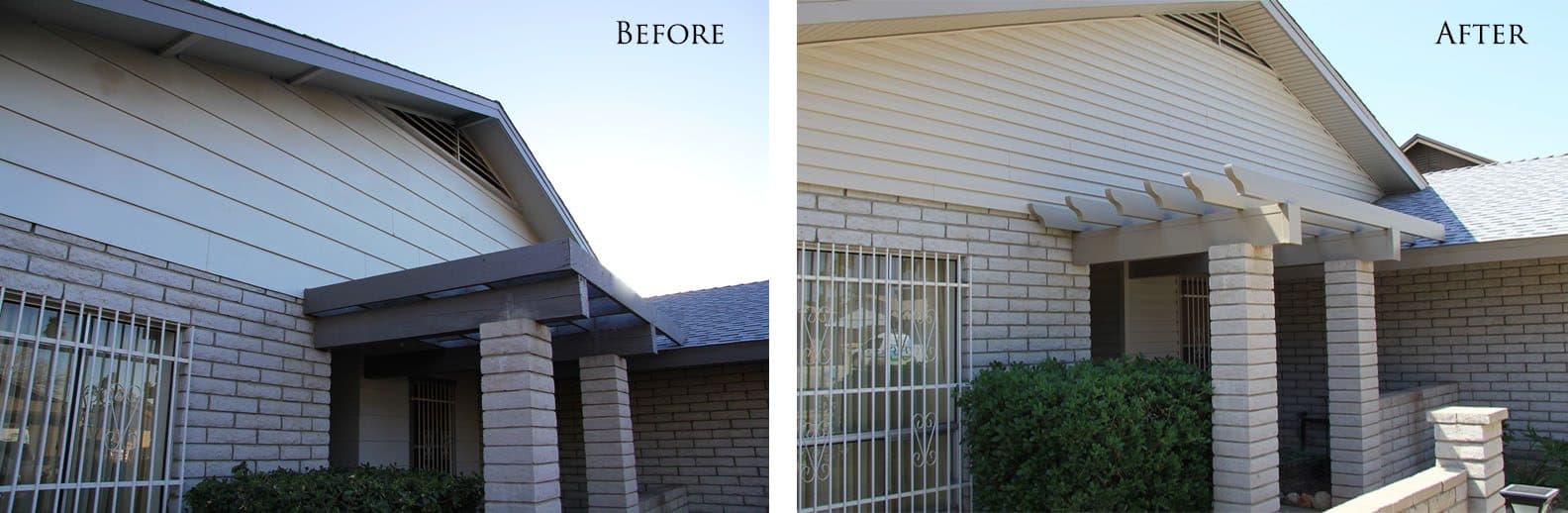
Most patio covers Phoenix homeowners look at come down to three choices: a fabric shade sail, an open pergola, or a cover built of aluminum. All three make shade. They part ways when it rains, when a summer storm blows through, and after a few years of desert sun.
Shade sails
A shade sail is a sheet of fabric, usually an HDPE mesh, stretched tight between posts or anchors on the house. The mesh lets air pass through, and rain with it, so a sail shades the patio but won’t keep it dry. The corners are often set at different heights, which helps the fabric hold its tension instead of flapping.
All of the load sits at the corners. Every gust pulls on the posts and the wall anchors, and sail makers advise rechecking the tension after big weather. Some say taking the sail down may be wise in places with extreme seasonal storms. In the Valley that’s a fair question: the National Weather Service office in Phoenix says most severe weather here comes from microbursts, with straight-line winds commonly 40 to 60 mph.
Pergolas
A pergola is an open frame of beams and rafters. It defines the patio and casts striped shade that slides across the floor through the day, and rain falls straight through it. A wood pergola keeps its rafters in full sun, so it needs sanding and paint on a regular cycle.
That’s the job pictured above: a gray painted wood porch pergola, replaced with aluminum lattice. The open look stayed. The painting didn’t.
Aluminum covers, solid or lattice
An attached aluminum cover is fastened to the house on one side and stands on posts on the other, so it becomes part of the house rather than a sheet strung across the yard. It comes in two styles:
- Solid: full shade, and it sheds rain. Insulated versions laminate a foam core between two aluminum sheets to slow the sun’s heat on its way down.
- Lattice: an open aluminum grid that shades part of the patio and leaves the rest in filtered sun. It fits a garden spot, or anywhere you want some sky overhead.
Neither one has any wood in it, so there’s nothing for termites or rot to get into, and the dust a monsoon storm leaves behind comes off with a hose. The patio covers page has photos of both styles.
How Phoenix patio covers compare
- Rain: a sail and a pergola let it through, and so does lattice. A solid cover keeps the patio dry.
- Wind: a sail depends on its corners and needs checking after storms. An aluminum cover is fixed to the house and to its posts.
- Shade: a sail shades only what’s under the fabric, and the shadow wanders as the sun moves. Pergolas and lattice let some sun through; a solid cover lets none in.
- Upkeep: a sail needs its tension checked, a wood pergola needs paint, and aluminum needs a rinse.
Start with the late afternoon
Before you choose, stand on the patio around 5 p.m. in July and note where the sun is. On a west-facing patio, the evening sun slants in under the front edge of nearly any roof. A deeper cover, or one that runs farther along the house, often does more than a different material would. If you mostly sit out in the morning, an east-facing patio may need less cover than you think.
While you’re at it
A new cover puts the eaves above it right in view, peeling paint and all. If the wood up there is worn, ask about soffit and fascia on the same visit. Our past work shows covers and trim from jobs around the Valley.
Want a price for your house? Call (602) 678-3737 or ask for a free estimate.