

Exterior stucco painting in Phoenix: how often should you repaint?
There’s no fixed schedule for repainting stucco in Arizona, but the walls give clear signs. What to check, why prep matters more than the paint, and why the wood trim sets the pace.
Stucco doesn’t come with a repaint date. The walls tell you when they’re due, and in the desert they tell you sooner than you might expect. Here’s the usual range, the signs to check for, and how to plan exterior stucco painting in Phoenix so the next job lasts.
How often exterior stucco painting comes due
KTAR’s Rosie on the House column has put stucco and masonry at about seven years between paint jobs, sooner if a house is already looking shabby. Another column in the same series argues that repainting every five or six years costs less than major repairs. Lighter colors tend to look good longer in the desert than dark ones.
The climate is the reason. Summer highs around Phoenix generally run from 105 to 110 degrees, according to a 1996 Weather Service climate summary for the area, and even December and January get close to 80 percent of possible sunshine. All that sun wears paint from the surface down: the sheen goes first, and then the top layer turns to powder.
Signs your stucco is due
- Chalk. Wipe a dark towel across a south or west wall. If it comes away dusted with color, the paint is breaking down.
- Cracks. Any crack wider than a credit card is thick means the walls are due.
- Trouble at the base. Peeling paint or bare patches where the wall meets the ground.
- White crust. A white, crystal-like deposit is salt that moisture carried out of the stucco. It has to be cleaned off before paint goes on, and it’s worth finding where the water is coming from.
Check the stucco garden walls and fence walls too. They take the same weather as the house, so look at them in the same walk-around.
Clean, patch and fill before paint
Paint won’t hold on a dirty or crumbling wall. Before the first coat, the wall is washed to get the dust and chalk off, damaged stucco is patched, and cracks are filled. Painters usually fill cracks with an elastomeric compound, which stays flexible and helps keep water from seeping in.
Elastomeric or acrylic
Elastomeric wall coatings stay stretchy, so they can span small cracks. They also let very little water vapor pass, which can trap moisture inside the wall, and they can be hard to remove or recolor later. The Northwest Wall and Ceiling Bureau, a trade group for the plaster industry, says they shouldn’t be used to fix a water or flashing problem, and recommends a breathable paint made for exterior stucco. Acrylic finishes made for stucco are typically very breathable. Elastomerics can still work on a wall with good flashing and drainage, so the choice depends on the wall. We can sort out which one suits yours at the estimate.
Before you buy paint, ask your HOA whether it keeps an approved color list.
The wood trim sets the pace
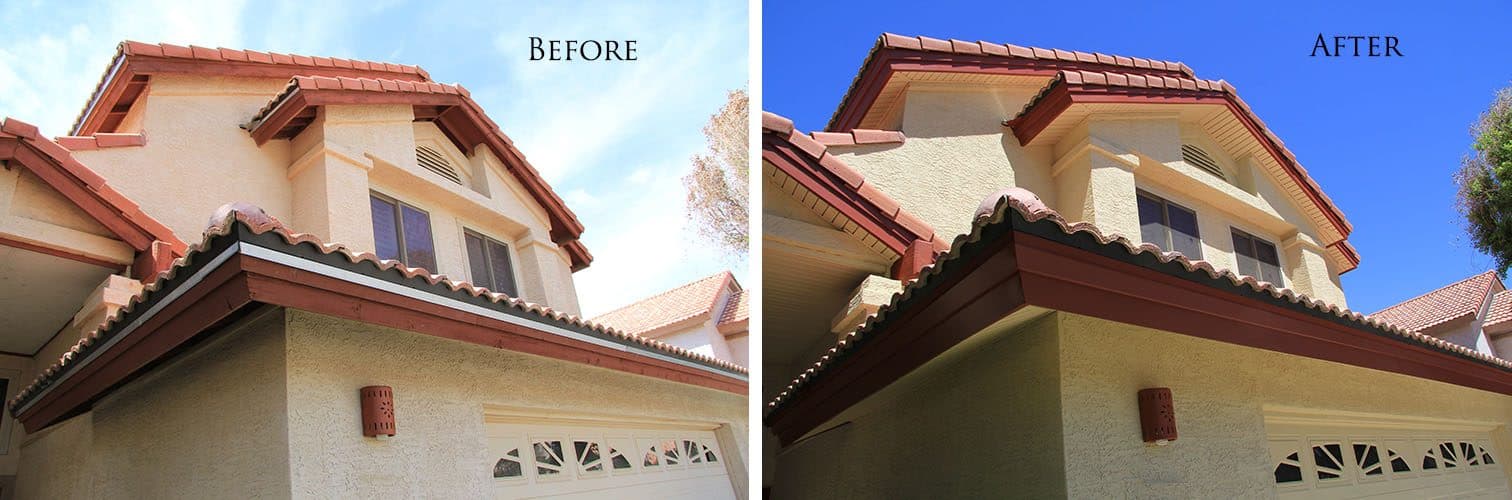
Stucco holds paint longer than wood does. If the fascia and the eaves are painted wood, they’ll be peeling long before the walls need another coat, and touching them up means ladders and color matching every time. Cover that wood with aluminum fascia and vinyl soffit, and the next paint job is walls only.
Pictured above: a two-storey stucco house whose worn, red-painted wood fascia was wrapped in aluminum and whose open eaves were closed with vinyl soffit. See soffit and fascia for how that’s done, siding for wood gables, our painting page for stucco work, and the gallery for more.
While you’re walking the house, look up at any wood patio cover. Dark patches on the rafters can mean rot or mold. An aluminum patio cover takes that framing off the paint schedule for good.
Want a price for your house? Call (602) 678-3737 or ask for a free estimate.