

Bird block on Arizona tile roofs: bird stop, eave closures and closed soffits
Birds move into the eaves through the open ends of roof tile and the gaps between rafters. What bird block, bird stop and a closed soffit each do, and what to know before sealing a nest in.
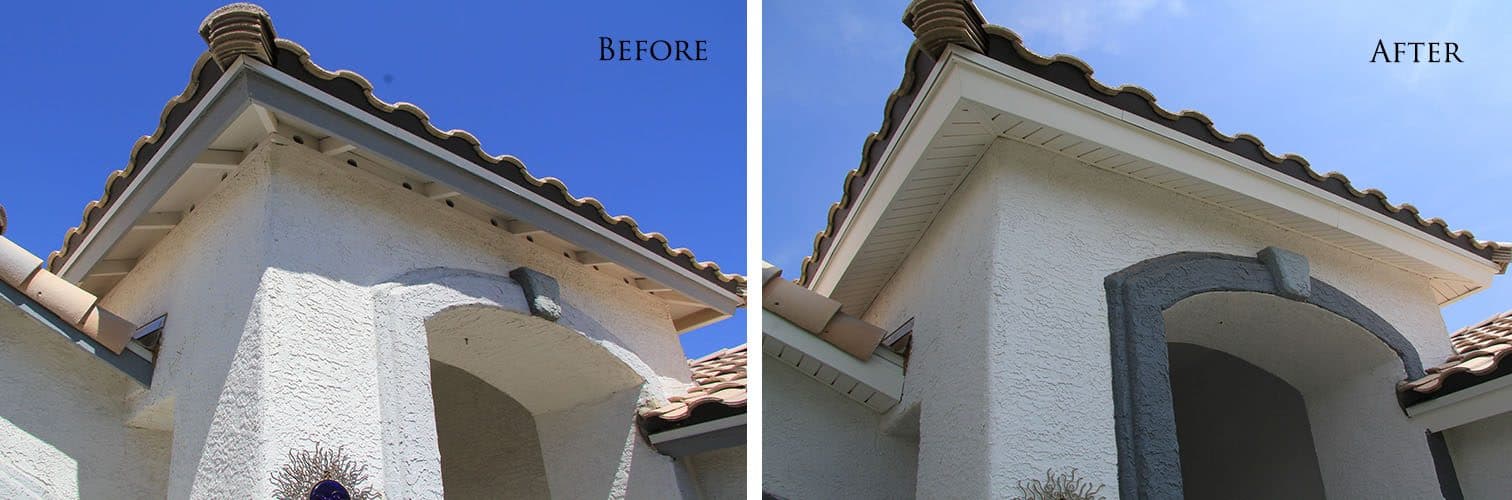
Straw poking out from under the bottom row of roof tile, or scratching above the patio at dawn, means birds have found a way into the eaves. On a tile roof in Arizona the fix usually has two parts: bird block to plug the tile ends, and a closed soffit underneath. Here’s what each part does, and why the names get mixed up.
Where birds get into a tile roof
Barrel tile is curved, so where the roof stops, every tile in the bottom row ends in an arch-shaped hole. Below the tile, an open eave has rafter tails with bays between them, sometimes with vent openings at the top of the wall. A fascia board that has split or pulled loose adds one more way in.
Pigeons nest on buildings wherever they find flat surfaces and ledges. Starlings will use almost any hole or cavity, and house sparrows favor building vents. According to University of Arizona Cooperative Extension, pigeons breed year round and reuse their nests, so a gap that gets claimed tends to stay claimed.
Bird block, bird stop, eave closure: three names, two jobs
- Bird stop, also sold as an eave closure: a metal strip set under the bottom row of tile. It fills the curved opening under that row and lifts it to the right rise, so it lies at the same pitch as the rest. Vented versions have small weep holes so air can move under the tile.
- Bird block, the carpentry meaning: short blocks set between the rafters where they rest on top of the wall. They keep the rafters evenly spaced and keep animals out of the attic. Some are made with screened vent holes.
- Bird block, as our crews use it: the closure at the open tile ends. When our job notes say bird block, that’s the part they mean.
Start at the roof edge
Drip cap, or drip edge, is the bent metal strip that caps the edge of the roof deck. The closure and the bottom row of tile sit right on that edge, so if the drip cap is missing or damaged, replace it while the tile edge is open.
Then close the soffit
Bird block seals the tile ends. The rafter bays underneath are the other open space. Closing the soffit with vinyl panels shuts those bays off, so there’s nowhere left to perch or build. Split or soft wood gets repaired before the panels go up, and it’s worth asking how the attic will keep venting once the eave is closed.
How tight does it need to be? New Mexico State University’s extension guide on nuisance birds says to close openings larger than 3/4 inch to keep out house sparrows, and larger than 1 inch for starlings. The open end of a barrel tile is far bigger than either.
Know what’s nesting first
Rock pigeons, house sparrows and European starlings are introduced species, and according to the U.S. Fish and Wildlife Service the Migratory Bird Treaty Act doesn’t cover them. Native birds are a different story. If you aren’t sure what’s living in the eave, find out before anything is removed or sealed in, so you don’t disturb a protected species’ nest.
Food keeps a flock around. Phoenix is one of several Arizona cities with an ordinance against feeding pigeons, and closed eaves take away the places they nest.
Cleaning up after them
Old nests and dried droppings can carry disease. University of Arizona Cooperative Extension advises against scraping, sweeping, vacuuming or power-spraying them dry, because that puts spores and particles in the air. For small, fresh deposits outdoors, wet the area down first, wear disposable gloves and an N95 respirator, and clean gently. A heavy buildup of droppings and nest material is a job for professionals.
In the photo above, a tile-roof gable goes from painted open rafters to a closed vinyl soffit. The roofing page covers the tile edge, the soffit and fascia page walks through a full tile eave job, and the gallery has more.
Want a price for your house? Call (602) 678-3737 or ask for a free estimate.